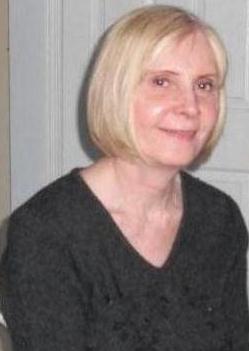
For author and editor Sigrid Macdonald, coming to terms with her sexuality is a lifelong struggle.
Macdonald identifies as bisexual but says she was ambivalent about publishing her bi-themed e-books, The Pink Triangle and April’s Return, under her name.
Now 60, she says she feels the need to be true to herself and her readers.
“From a purely moral standpoint and from a position of integrity, I thought, ‘If I can’t own my stories at my age, it is a bad message that I am sending to other people,’” she says.
Born in Canada, Macdonald moved to the US with her family before returning to her birth country to attend graduate school in Toronto. After working as a political and non-fiction writer for decades, she felt the itch to produce fiction.
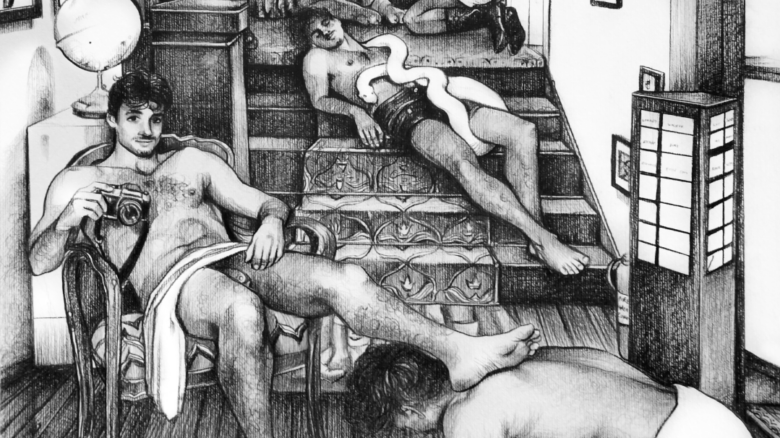
Partially inspired by events from her own life, The Pink Triangle details the budding love affair between two teenaged friends, while April’s Return follows up with the duo in adulthood.
“They came from a lot of different places,” Macdonald says of the novels. “Mostly just finally wanting to be myself and write about something that is close to my heart.”
Friendships are frequently undervalued, yet they can be just as tumultuous as marriages, she says.
“Friendships sometimes survive for decades after a marriage has ended. In my life they have been the glue; not to say that my relationships haven’t been, but my friendships have been a constant,” she says. “Yet there is friction in friendships.”
Author Susan Litt says Macdonald’s books have struck a chord.
“Guarded by angels as we frolic through our youth, the author of The Pink Triangle reminds us of how special and fragile the blessings of friendship and family are,” Litt says. “How carefree and unburdened the buoyant days of discovery. A cautionary tale of true trust and love lost, carelessly overlooked, gone, perhaps forever.”
Macdonald describes The Pink Triangle as “bittersweet,” while April’s Return, she says, is more upbeat and romantic.
“[By April’s Return] they have grown up and finished making their mistakes. The hardest part is over for them,” she says.
Macdonald’s first book, D’Amour Road, may reference love in its title but is in stark contrast to her sexually charged tales.
In the 1980s, Macdonald created an Ottawa support group for David Milgaard, whose wrongful conviction for rape and murder made headlines for decades. A woman she met in this group, who welcomed a convict into her home, inspired her first fiction effort.
“She went missing. He had murdered her,” Macdonald says. “I didn’t want to write the non-fiction version of that, but the story just haunted me for years and years.”
Yet D’Amour Road isn’t only about the pain of losing a friend. Macdonald worked many of her own issues into the novel, she says, including a subplot about a mid-life crisis.
She says she hopes to write more queer fiction in the future. “I would really like to,” she says. “I like romance. It is a big part of me. It is a part that I had to stifle for a long time.”
Although Macdonald is now out and proudly takes credit for her work, The Pink Triangle and April’s Return are available under her pen name, Tiffanie Good.

 Why you can trust Xtra