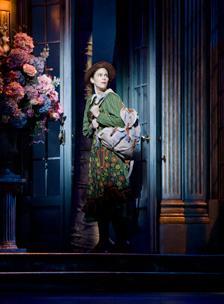
Hitler’s “quiet invasion” of Austria in 1938 inspired a three-hour musical tour de force, beginning with an opening night performance starring Mary Martin in 1959 and soaring into cinematic history only six years later with Julie Andrews’ memorable representation of one randy nun who finds spiritual and sexual solace in the gorgeous but politically volatile Austrian alps. As Maria Rainer, soon to become Maria von Trapp, the central heroine of this iconic romp represents a prime example of musical theatre’s penchant for damsels in distress who sing their way in and out of the hearts of many. And now we have our own fair Canadian damsel, Elicia MacKenzie, making her way through the arduous trials of reality television and into her first starring role in the current Andrew Lloyd Webber/Mirvish production of The Sound of Music.
After months of rehearsals and a summer of primetime CBC exposure, MacKenzie won out over dozens of warbling hopefuls as the victorious contestant of How Do You Solve a Problem Like Maria? It was well worth the effort. Mac-Kenzie, although barely a decade older than the eldest of the von Trapp children, rises above slight casting incongruities and delivers a delightfully nuanced performance. Her beautiful voice and vivacious onstage energy make her a perfect Maria. Burke Moses as Captain von Trapp, although pleasantly buxom and built for endurance, bears a bit of an anomalous presence alongside the sheer youth and vitality of his costar. The somewhat sharp quality of Moses’s speaking voice — in contrast to his powerful singing voice — gives his character a used car salesman persona and not enough aristocratic nobility. His charming rendition of “Edelweiss,” however, endears him to one and all as the family makes their famous escape from one musical moment to the next.
The von Trapp children will bring tears to your eyes as they charm with every move and reveal abundant talent as child stars who delight without being irritatingly sweet. Of course the nuns are what hold this show together as they open the evening with a monumental entrance into the aisles of the theatre, led by the amazing vocal talents of Noëlla Huet as the Mother Abbess, aided beautifully by Jayne Lewis, Mary Ellen Mahoney and Jennie Such as sisters Berthe, Margaretta and Sophia. The entire ensemble shines with breakneck pacing and sufficient acting skills to bring the politics and the romance into sharp focus, culminating with an awe-inspiring Nazi banner that covers the roof of the entire theatre which makes us all feel complicit in the so-called quiet invasions that continue to mark the history of political warfare.
This is a first-rate production of Richard Rodgers’ spectacular score, with sets by Robert Jones that literally move with monumental agility, proving beyond the shadow of a doubt that the hills are still alive with the explosive sound of magical and memorable music.
 Why you can trust Xtra