As early as the late 1970s, a question began to percolate about the relationship between the photographer and the subject. It was determined that a photographer with a camera was in a position of power, and there was concern that a person photographed was a person exploited. In her 1977 book On Photography, Susan Sontag wrote: “To photograph people is to violate them, by seeing them as they never see themselves, by having knowledge of them they can never have; it turns people into objects that can be symbolically possessed.”
This question continued to fester. It has to do with who was representing whom and who had the right to do so; the argument being that you could never accurately represent someone else’s experience and circumstances, unless you belonged to that same cultural group. In other words, only lesbians could speak, write or make art about lesbians.
As a result, many photographers came up with alternate strategies. Jon Baturin is one of them. His new show at Gallery 44, About Ends (The Hope Project) consists of collaborative portraits. Baturin and his collaborators, friends and acquaintances he invited to participate, decided together how the portrait should turn out. As the series title suggests, each portrait deals with the collaborator’s hopes, be they general or specific. If a collaborator doesn’t like the result, Baturin promises to destroy it (he has not yet been asked to do this).
The photos of Baturin’s collaborators are largely consistent: large-scale colour head-and-shoulders shots (with one significant exception that I’ll get to later). The portraits often consist of many parts and always incorporate text written by the collaborator.
Taken together, though, the pieces are bland.
I was left with many questions to which I couldn’t find answers, and not in the good way art can raise questions. Questions like: I wonder what that text means? (One portrait includes Mandarin text and two others French text.) One collaborator, Guy, died of AIDS, and that made me wonder whether all were living with HIV/AIDS and is it relevant to the project and my understanding of their lives? I assume so, but couldn’t say for sure. This was ultimately frustrating.
It is clear that each portrait meant something both to Baturin and to his collaborators. Baturin has taken a lot of care with the photographs, which are superbly lit and printed, and with the presentation. Everything is meticulously done. But the theory of the collaborative portrait is not as good as the practice. There is an interaction represented but one that means a lot more to the collaborators and leaves me as the viewer to wonder what I’m missing out on and why I haven’t been invited to the party.
Now for the significant exception: There is one portrait that transcends the closed system of the collaboration and that’s because it tackles issues that extend beyond personal specificity.
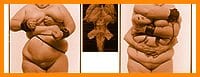
Jenn #1, 2001, is a triptych, two large images and one small one placed between them. Jenn is naked except for a string of pearls and leather cuffs on her wrists joined by a length of chain. She is represented from the shoulders to the upper thighs, and this section of her body fills both large panels. In the first, she pulls the chain around her body, pinching and displacing her flesh. Baturin’s arms also encircle her torso just below her breasts. In the second, Jenn, still shackled, wraps her arms around herself, as does Baturin.
The third, smaller image is a clinical, but gruesome, anatomical image (Baturin inherited the anatomy archive of a medical photographer colleague upon his retirement). It depicts what could be the skinned shoulders, torso, waist and hips of a thin woman, over which is superimposed the text “desire into reality.” This ambiguous image suitably evokes the meat-like quality of the human body and the radical carving up that would need to take place for Jenn to achieve the socially acceptable shape. The juxtaposition is startling – we don’t after all like to think of ourselves as merely hunks of flesh – but it works to draw attention to the way bodies are so often offered up in advertising images.
There is also a gash over Jenn’s left breast, one of those happy accidents that occurred as someone at the photo lab dropped the negatives on the floor and stepped on them while trying to find them. Together with the leather cuffs this further widens readings of the piece and signals SM practices.
In her portrait, Jenn comes to stand for every woman who has ever been dissatisfied with her body and who has resented the barrage of images of impossibly thin women in magazines, movies and on television. The photographic depiction of her physical struggle with herself is a powerful use of the medium that is so often used to seduce us. Jenn has both been seduced by and rejected such normalizing representations of femininity and sexuality, and that paradox lives in her portrait.
This piece gives me (dare I say it) hope for the rest of the series. But different photographers do pull different qualities from their subjects, which is why a Herb Ritts portrait of Madonna is distinct from a Mario Testino one. The fact remains that we are interested in individual vision, the stronger the better. Sontag’s comment is I think the point of making photographs. These different versions of the world are what give art its currency and what keeps us coming back for more.
* About Ends (The Hope Project).
Till Sat, Jul 6.
Gallery 44.
401 Richmond St W, #120.
(416) 979-3941
 Why you can trust Xtra