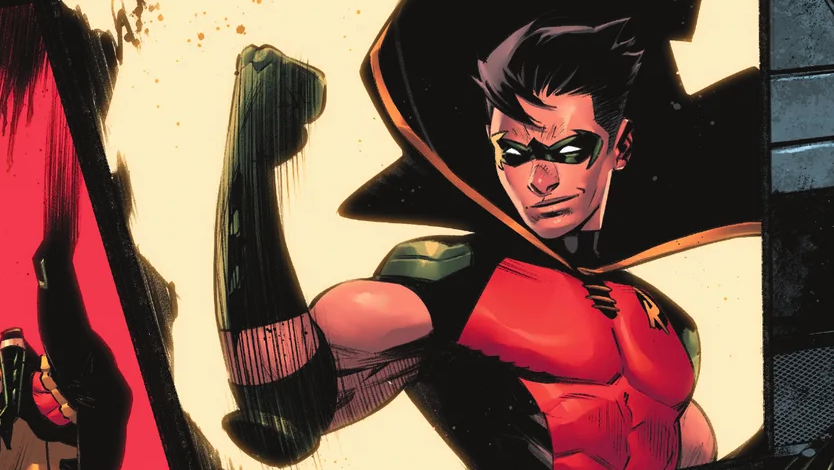
After 80 years of speculation and jokes—and the nippled Batsuit from the 1990s—the homosexual subtext has finally become text: Batman’s longtime sidekick, Robin, is queer. Well, at least one version of him, anyway.
In the DC comic Batman: Urban Legends #6, released this week, Tim Drake, a.k.a. Robin, agrees to go on a date with his male friend Bernard after Robin rescued him from a villain and had a “lightbulb moment.”
“It always felt just out of reach. Until now. Until right now,” Drake muses before accepting Bernard’s invitation.
Debuting in 1989, Drake is the third iteration of the character, following Dick Grayson and Jason Todd. His revelation comes courtesy of writer Meghan Fitzmartin and artist Belén Ortega.
In a piece for NPR, Glen Weldon pointed out that, like so many of us, Drake’s Robin didn’t explicitly come out as gay or bisexual, but rather just expressed an interest in dating men.
“You’ll see some coverage declaring that Tim has come out as bisexual, but that’s not technically true. Yes, he’s dated fellow hero Spoiler (Stephanie Brown) on and off. But his journey is just beginning, and Tim is still figuring himself out—he hasn’t applied any specific labels to himself yet, and his creators haven’t either,” Weldon wrote.
“It stands to reason, too, that his coming-out process would be one marked by a halting, introspective approach.”
In an interview with Polygon, Fitzmartin agreed, saying there’s no rush to label Drake.
“I wanted to pay tribute to the fact that sexuality is a journey,” Fitzmartin said. “To be clear, his feelings for Stephanie have been/are 100% real, as are his feelings for Bernard. However, Tim is still figuring himself out. I don’t think he has the language for it all… yet.”
If you’re keeping track, Drake isn’t even the first member of the Bat family to come out. Batwoman has been openly queer since 2004 (with versions of her memorably played by openly queer actors Ruby Rose and Javicia Leslie on TV), and villains Harley Quinn and Poison Ivy were recently confirmed to be in a relationship.
But Robin’s coming out in particular has been anticipated for decades: he literally shares a bed with Batman in some of the early comics, and the original character’s name is Dick. Back in the day, homophobic psychiatrists even blamed the Batman comics for indoctrinating kids into homosexuality.
And, of course, the character memorably appeared in openly gay director Joel Schumacher’s 1997 camp classic Batman & Robin, which is rife with both homoerotic subtext and literal nipples on the characters’ outfits.
Needless to say, fans were thrilled by the long-awaited revelation.
Now let’s see the queer Winter Soldier we’ve all been waiting for. Your move, Marvel.

 Why you can trust Xtra