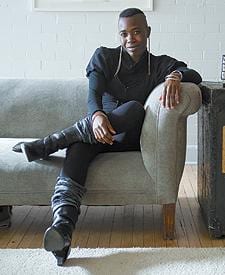
You’d be hard-pressed to find an artist more prolific and hard-working than d’bi young. The 32-year-old Jamaican-born, Toronto-based, queer dub poet, writer and performer has recorded four albums, published two books, contributed to numerous compilations, written half a dozen plays, won two Dora Awards and performed on stages across the Americas and Europe. She is the founder and artistic director of anitAFRIKA! Dub Theatre, a company that teaches dub poetry to youth, and has taught and lectured internationally.
Currently on a year-long performance tour that is taking her across Canada and to Ecuador, Belize and England, young is doing her best to balance her many projects with life as the single mother of two young children. So how exactly does she manage to do it all?
“I don’t know!” she laughs, on the phone from Montreal, where she’s currently performing. “Some days I’ll have three or four hours before rehearsal that I plan to use working on lines or something. But you know, I’ll spend the whole time making food and changing diapers.”
Her newest piece, She, which explores a young woman’s obsession with a pop icon, is being presented as part of the second week of Rhubarb at Toronto’s Buddies in Bad Times. The piece is the first part of a new trilogy entitled She Raw Now, which examines “the state of affairs of the world today.”
“The work started with looking at Rihanna as a pop-cultural figure, what she’s going through and what she’s consenting to,” young says. “My work is often about how we acknowledge and use our power, and so in looking at Rihanna I wanted to examine my own boundaries and limits in terms of what I can say.”
She stresses that the pop-singer character in the piece is not Rihanna specifically but a mould of different female performers over time.
“If you look at what’s happening to Rihanna and how the media is treating her, it’s nothing new,” she says. “It happened to Madonna, to Brandy, to Britney. There is a system at work here for artists who are seduced into this idea of what success is. The piece is less about pointing fingers than it is about looking at community expectations.”
Most of young’s works are solo shows that she writes and performs herself, a brand of theatre she calls “biomyth-monodrama.”
“Biomyth is a form of creation where the author uses biographical information as a starting point and then employs poetic licence to broaden or deepen it,” she says. “Monodrama is about combining the traditions of dub poetry and theatre that I came out of.”
The other part of the equation is to provide a talkback after the work is presented.
“I’m learning that I can’t present provocative subject matter and expect my audience to go home and be okay,” she says. “There has to be a process where we can dialogue about the work. A storyteller is there first and foremost for the transformation of the community, and they must be responsible to the people who will allow them to be on stage.”
Her work is obviously personal. So personal, in fact, that it is often read as a literal retelling of her life experiences.
“My personal life is the catalyst for my work because the story I am going to tell has to be rooted in some kind of truth,” she says. “I don’t write autobiographies but I also try not to write about things I don’t know about. I know about myself, my family, the many intersecting communities that I participate in, and so I use those things as my starting points.”
With all the different forms she works in, young still defines herself first and foremost as a storyteller. “For me, being a storyteller is about having integrity,” she says. “If I’m not living my truth and being honest in my life, my work will be coloured with that energy. It’s not a job you can separate yourself from. It’s something you have to live every day.”
The equation seems to be working for her, if only because of the numerous opportunities she has for creating and presenting her work.
“I absolutely can’t complain about not getting to do my work,” she says. “That’s a major issue for a lot of other artists, and I have a huge amount of privilege simply in that my voice is able to be heard.”
She stresses that privilege also comes with a hefty side order of responsibility.
“I have to be accountable to the people who are putting me on stage and listening to the things I’m saying,” she says.
“It’s not just about the work, but about the person that I am and the choices I make in my life.”
Being able to meld her life as a mother and her life as an artist has always been challenging, though young seems relatively unfazed by it.
“If you look at the history of our communities, women were back working on the plantations with the child strapped to their back as soon as it was possible,” she says. “I don’t think what I’m doing is that crazy or that special. It’s not that different from what we’ve always done.”
 Why you can trust Xtra