The film that caused such a fuss among some American conservatives that it was pulled from an exhibit at the Smithsonian didn’t raise many eyebrows at its first Ottawa screening.
About 100 people took in A Fire In My Belly by David Wojnarowicz during three successive screenings in the single-room exhibition space of Bank St’s Gallery 101 on Saturday night. Two screenings were originally planned, but organizers added a third due to demand. Most people had come out to see for themselves what was creating so much controversy but couldn’t understand what caused the United State’s most well-known museum to remove the film.
“I don’t know what the fuss is all about,” said Janet Clayton after the second screening. “I don’t see what’s so upsetting about it.”
“I expected a lot more,” said Joseph Jacques, who works for the AIDS Committee of Ottawa.
Jacques acknowledged, however, that the people who complained about the film in Washington were more conservative than he. They included members of the Catholic League and John Boehner, the new Republican House speaker.
The removal prompted a large public outcry, with many calling it an act of censorship.
One of the organizers of the Gallery 101 screenings said he is happy that the controversy around the film is increasing its visibility.
“More than anything, I think the controversy is important if it gets people to see the film,” said Glenn Crawford, who is also the committee chair of The Village.
The gallery screened two excerpts from the film, one 13 minutes and the other seven minutes long. Wojnarowicz, who died of AIDS, never completed the piece. The Smithsonian was screening just four minutes of it at the National Portrait Gallery in Hide/Seek: Difference and Desire in American Portraiture, which also happens to be the first major museum exhibition to focus on gay portraiture.
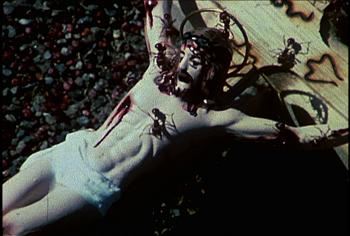
All the controversy was about an 11-second clip that shows Christ’s body, bleeding on the cross, being walked over by a swarm of ants (see it here: http://www.washingtonpost.com/wp-dyn/content/video/2010/11/30/VI2010113006898.html).
The excerpts screened on Saturday night showed an abstract, freely flowing variety of scenes in a type of stream-of-consciousness display. Images of a cock fight, industrial gears turning, a marionette dancing and then catching on fire, and blood falling into a glass bowl were all juxtaposed. There was also a set of human lips slowly being sewn shut with a needle and thread, and a man masturbating. Wojnarowicz created the film in memory of a friend who had died of AIDS.
Gallery 101 follows several other museums around the world, including London’s Tate Modern art gallery, in screening A Fire In My Belly to protest the perceived censorship and show support for Wojnarowicz, who also died of AIDS.
Meanwhile, the only Canadian artist featured in the Smithsonian’s gay portraiture exhibit continues to try to get his own work removed in protest. AA Bronson’s portrait of Felix Partz is owned by the National Gallery of Canada, which refuses to formally ask the Smithsonian to take it down. Instead, the Canadian gallery has asked the Smithsonian to “collaborate” with Bronson, he says.
Bronson adds that the National Gallery told him that to force the removal of his work would be “fighting censorship with more censorship.”
He, of course, disagrees. “For me to remove my work is not censorship. If I was removing somebody else’s, that might be censorship.”
 Why you can trust Xtra