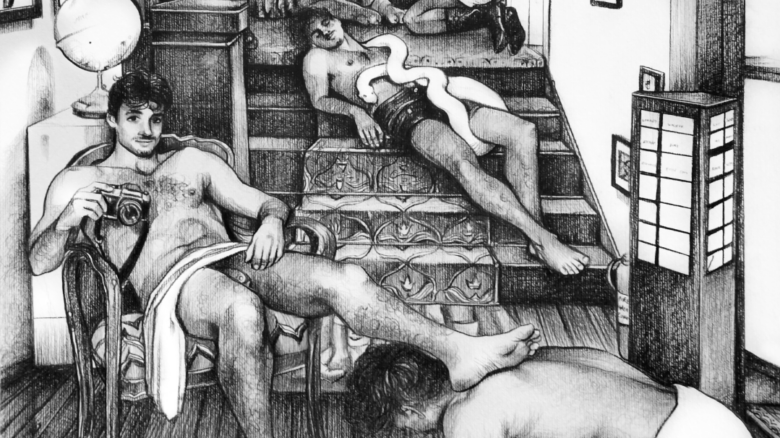
University of Ottawa student Jordan Clayton wants you to question gender norms.
His new show, titled Male/ /Female, explores the fluidity of gender and internalized homophobia. Clayton took time before his vernissage to answer questions from Xtra about his sexual work and his own coming-out process.
Xtra: Did you experience internalized homophobia yourself? I would agree that many young gay men continue to self-hate. If yes, how did you personally tackle this and come to terms with your own sexuality?
Jordan Clayton: Looking back on the past couple years I would say that I have not felt the need to self-hate after coming out. I was fortunate to come out to a very accepting and loving support group, which happens to include my close family. Though the process of coming out was difficult on me, it allowed me to grow up very quickly into an individual with the presence of mind to accept and love myself as much as those around me.
That said, fresh out of the closet I was one who idealized masculine men and feared alternative gender. I am very proud that I have left those ideals behind and opened my mind to conceptualize the fluidity of gender expression.
What has the reaction from your instructors and fellow students been? Has there been any negative or homophobic reaction?
The body of work to be presented was painted in my own personal studio, so I have not received input from the instructors. However, I do anticipate an interesting and positive reaction, based on the reaction to my previous work. The peers that have seen my work in progress for the show have reacted positively and have expressed interest in what I have to present about my thoughts on gender.
The addition of stereogram paintings is an original attribute to your work. Do you feel this effect gives the work more depth or is it simply for the visual impact?
The decision to create stereograms is a way to both invoke reaction and provoke thought. The show is centralized around dichotomies, and I believe the presentation of a left/right image of a stereogram is both literal and tongue-in-cheek. The fusing of the images with the viewer forces the viewer to accept the presence of a gender spectrum.
The show is titled Male/ /Female. Do you consider yourself 100 percent male, or is there some fluidity to your own gender identity?
Currently, I identify as a gay man; however, I find labels to be limiting and that they invite the possibility for one to be faced with a degree of adversity. I’m unsure of how I will choose to identify in the future – if I choose to identify! Whatever that choice may be, I shall make it proudly.
Jordan Clayton’s Male/ /Female vernissage
Friday, March 15, 5:30pm (on display until March 22)
Gallery 115
100 Laurier Ave E
“At the Bottom of the Faggot Tree”
.jpg)
“Inner Diva”
.jpg)

 Why you can trust Xtra