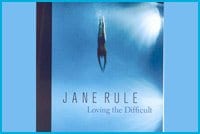
Loving the Difficult is a collection of essays written by Jane Rule between 1990 and her death in November of last year. Rule retired from fiction writing following the publication of After the Fire in 1989, but that doesn’t mean she stopped writing. Some of the pieces have been previously published, many appear for the first time. According to the publisher the order of the essays was chosen by Rule herself and they are organized thematically rather than chronologically. The book comes out this month from the small west-coast publisher Hedgerow Press.
The first half presents pieces that are about the practice of writing, the role of the writer and the nature of censorship. There are a number of pieces that focus on questions of teaching or mentoring, a Rule specialty. This is the voice and world-view that most of us think of when we think about Rule. The clarity of her thinking is remarkable and her commitment to the general cause of sexual freedom in all of its forms and expressions has never wavered.
Her ability to address controversial topics such as appropriation of voice in fiction or sexism in publishing in a succinct and pragmatic way is a rarity, and it seems to me the loss of that voice is what we might come to miss most with her death. She was fiercely opposed to marriage — for everybody — because of the way the institution of marriage privileged one flavour of relationship over others. For her that represented both an injustice and unnecessary meddling or regulation of something that ought to fall into the category of individual choice.
The second half of the book is an interesting mix of personal storytelling that culminates in an examination of the nature of loss. While many of the later essays weren’t necessarily written in the last year of her life, positioning them at the end of what she knew would be the last book she would write brings an additional poignancy.
There is some intensely personal writing which gives the collection a memoir- like quality, compounded by some wonderful photographs, ranging from early childhood through adolescence up until Rule’s final year. Like the essays themselves they aren’t organized chronologically and most of them aren’t dated, which doesn’t reduce their appeal it just seems somewhat unsatisfying.
There is a great deal of childhood reminiscence: about her parents, her siblings and particularly her grandparents who featured prominently in the summers of her childhood. There is perhaps too light an editorial hand at work in some of the essays; some anecdotes are repeated too often. On the one hand, there is the legitimate sense that we are listening to a respected elder who can be forgiven for having a told a story on more than one occasion, but on the other, that repetition doesn’t work as well in print.
In many ways this collection serves as a memoir of both Rule’s life as citizen and writer. Because of the personal nature of much her work and the way her personal life was to a large extent lived in a very public way it is particularly difficult to separate the two. Being an open and outspoken lesbian who moved comfortably and relatively freely in the Canadian writing milieu still stands as a remarkable achievement in any decade but it is especially so given Rule’s arrival on the scene in the 1960s. Reading the collection serves as an eloquent reminder about how powerful her voice was and how the written word preserves that voice.
 Why you can trust Xtra