***
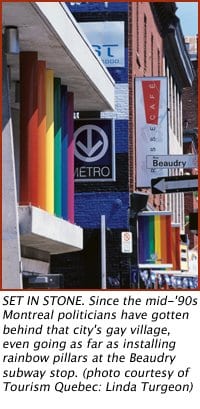
When Kevin Hatt left Montreal in 1986, there was no gay village on St Catherine East. In fact, the area around the Beaudry subway was looking like the entertainment district’s derelict cousin.
“Montreal’s village is new since I lived there, so it’s been interesting going back to see how it’s developed, says Hatt. “It brought life to the area, renewal, vibrancy, community.”
That transformation is under way in Ottawa. The city is preparing to tear up Bank St from Laurier to the Queensway to replace the aging pipes below. When they finish, Bank St will get a major facelift. Sketches of the proposed streetscape will be on display Mar 18 at the Centretown Community Health Centre.
For those who want to get a portion of Bank St identified as The Village, it represents a chance to make their voices heard.
“I would like to see — this is what I’ve always dreamed — is a place to meet that’s not a bar. Both the young and the old have requested it,” says Hatt. “We aren’t just commercial, the community aspect needs a place too.”
That space might be outdoors, if the sidewalks are wide enough and if there are lots of benches and parkettes. If Bank St can capture the vibrant neighbourly feeling of other gay neighbourhoods in North America, it will help bring people together across age groups.
“The one thing about the AIDS crisis, the most devastating part, is that a whole generation of mentors has been taken away,” says Hatt, who also works with the AIDS Committee of Ottawa. “So that’s what having community would be for us — a chance to encourage that spirit again.”
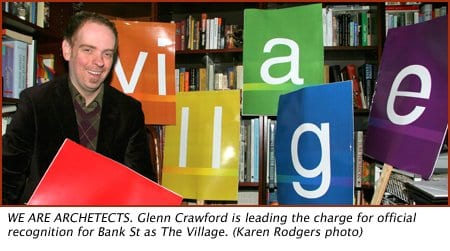
A survey conducted by Glenn Crawford last year shows broad consensus from the gay community on three key issues. Almost 90 percent of his online respondents said they wanted to see official recognition for Ottawa’s gay strip, running from approximately Nepean to James. As well, of the 326 people who filled it out, 86 percent want the six-stripe rainbow flag to be used to denote the special character of the neighbourhood. And they want it called The Village.
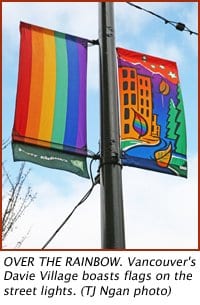
When it comes down to the details of what it should look like, there’s less agreement. The lion’s share said they wanted to see silk banners on the lampposts. Street signs with a special logo and rainbow flags were also popular. Other ideas, including archways at the beginning and end of The Village and plaques with our history, were further down the list.
“If I were interpreting the data, I would say the first two or three are the ones that are deemed necessary, the others are things that could be done eventually,” says Crawford. “As The Village grows, the amount of recognition it gets should increase.”
After the sketches are made public, people will be asked to make suggestions. Those suggestions will be taken seriously, say city planners, as the look for the area is finalized.
“Everyone’s welcome to make suggestions and if there’s an overwhelming desire for something, we’ll be able to consider that,” says Luke Foley, the project manager from the City of Ottawa.
Folks are encouraged to head to the The Buzz, a lesbian owned restaurant on Bank St, for drinks after the open house.
Already, the redevelopment is generating word-of-mouth. Pat Croteau, the chair of Mr Leather Ottawa, acknowledges that shutting down Bank St could hurt local businesses in the short-term, especially since the corner of Bank and Somerset was closed for two months in 2007.
“I’ve been up to the end of Bank St that’s already been redone, near Wellington St, and it looks much, much better,” he says. “Anything would look better.”
But Tom Ramsay of One in Ten isn’t sure how business will be affected in the short term.
“It could be better. Without the government workers walking by, we might get more people slipping in,” he says.
Still, he’s looking at all his options, including using Nepean St entrance during the construction. And after?
“As long we have asphalt and sidewalks, we’ll be happy. Maybe some planters,” he says.
Ramsay, Croteau, Crawford and Hatt have all pencilled the open house into their calendars.
“I believe that we can make a very positive contribution to the city as a whole,” says Hatt. “And it would be really great if it became a trend, if other cities saw what we did and used us as a model.”

 Why you can trust Xtra