BY NATASHA BARSOTTI — “I am here because when I was young, I wanted very badly to be a writer, I wanted to be a filmmaker, but I couldn’t find anyone like me in the world and it felt like my dreams were foreclosed simply because my gender was less typical than others,” film director Lana Wachowski told a Human Rights Campaign gala dinner crowd as she accepted a Visibility Award from the organization on Oct 20. 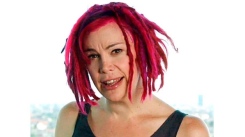
Wachowski, who came out publicly as transgender in July but has been out to her family and friends for more than a decade, delivered a speech that was in turns touching and funny. At one point, she recalled going to her hairdresser in preparation for the gala.
“He’s gay, go figure. I say, ‘Yeah, the HRC wants to give me an award.’ Award for what? I say, ‘I guess for kind of being myself.’ He’s like playing with my hair and looking at me and he’s like, ‘Yeah, I guess you make a pretty good you.’ And I was like, yeah, ‘Yeah, well there wasn’t a lot of competition.’ And ‘cause he’s a catty bitch he said, ‘Yeah, it’s a good thing — just imagine if you had lost.'”
Wachowski told the audience it was the first time she had been asked to make such a speech since her eighth grade graduation. Back then, she recalls, she tried to decline, but her high school teacher encouraged her to rise above her fears and shyness.
“He said he understood how I felt; no one likes giving speeches . . . but sometimes I had to think not just about myself but about my class and my parents, who would be very proud of me. There are some things that we have to do for ourselves, but there are other things that we have to do for other people,” Wachowski said.
“So I wrote this speech back then much as I wrote this one, with butterflies churning. I worked on it at night wearing the slip that I used as a nightie that I had stolen from my sister. I wrote about the way that knowledge had an actual materiality not unlike the materiality of a ladder that could be used to gain access to places and worlds that were previously unimaginable. I have no real memory of giving that speech. I remember afterwards being in the bathroom, hiding in a locked stall, feeling the slip I wore under my suit as I cried, feeling stupid and that I was a liar because I was unable myself to imagine a world where I would ever fit in.”
Wachowski spoke about writing a four-page suicide note after school. “I’m a little talkative. But it was addressed to my parents and I really wanted to convince them that it wasn’t their fault; it was just that I didn’t belong. I cry a lot as I write this note, but the staff at Burger King has seen it all before, and they seem immune,” she said as the crowd laughed. She recalled going to a train station with the note attached to her backpack and trying to think only of jumping. But the riveting stare of an old man who wore glasses that reminded her of the ones her grandmother wore stopped her.
“I don’t know why he wouldn’t look away. All I know is that because he didn’t, I am still here,” she said.
Wachowski, who directed The Matrix trilogy with her brother, Andy, also addressed the challenges of negotiating private and public identity. “People have mistakenly assumed that this has something to do with my gender. It does not. After The Matrix was released in ‘99 we both experienced this alarming contraction of our world and thus our lives. We became acutely aware of the preciousness of anonymity — understanding it as a form of virginity, something you only lose once. Anonymity allows you access to civic space, to a form of participation in public life, to an egalitarian invisibility that neither of us wanted to give up.”
Visit The Hollywood Reporter for more of Wachowski’s speech.

 Why you can trust Xtra