Though he’s penned essays, novels, biographies and memoires, gay American writer Edmund White hasn’t been known as a playwright in his nearly six decades at the keyboard. That may be why Toronto theatre artist Alistair Newton hadn’t heard of White’s 2006 play Terre Haute when he interviewed him last January.
“It came up during our conversation I ran a theatre company, and he offhandedly suggested I give the piece its Canadian premiere,” says the creator of The Pastor Phelps Project and Of a Monstrous Child: A Gaga Musical. “I tracked down a copy and found it so transgressive, I felt compelled to do it.”
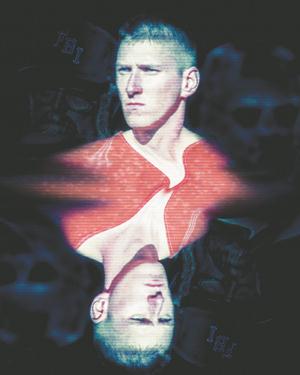
Though White’s play isn’t well known, its background story is. On April 19, 1995, decorated Gulf War veteran Timothy McVeigh detonated a bomb outside a government building in Oklahoma City, killing 168 people, including 19 children, an act he considered retribution for the government’s botched raid of the cult leader David Koresh’s compound in 1993, which resulted in 83 deaths. Executed in 2001, McVeigh exchanged letters in his final years with another gay American writer, Gore Vidal.
Vidal was writing a series of articles on McVeigh for Vanity Fair; the letters formed part of his research. Though they never actually met, a curious pen-pal relationship developed between the pair, which White reimagines as a psychosexual drama set in the maximum-security prison in Terre Haute, Indiana, where McVeigh spent his final days.
“It’s a fascinating twist on the relationship where McVeigh sees Vidal as a sort of grandfatherly figure he can learn from and Vidal sees McVeigh as a dangerous sex object,” Newton says. “It says a lot about masculinity and the dark side of gay male sexuality, how gay men are often attracted to these rough-trade types that arouse and threaten them at the same time.”
Beyond simple sexual tension, the work posits challenging questions about violence, namely that all perpetuators of bloodshed see its justification in achieving their political aims.
“We have this infinite loop, terror fighting terror, in the world,” Newton says. “Whether it’s Timothy McVeigh or Janet Reno, John Ashcroft or al Qaeda, all of them will tell you the ends justify the means. It just depends what side of the argument you are sitting on, whether you agree with them or not. If you’re going to deal with the ramifications of an act of terror, you have to engage with the rage that breeds it.”
For more on Vidal, read Matthew Hays’ interview with the late trailblazer.

 Why you can trust Xtra