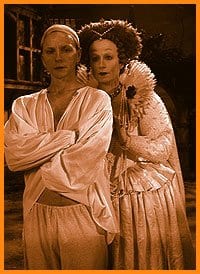
Trust the CBC to stick a play on the tube and call it television.
Elizabeth Rex, Timothy Findley’s play about a Queen who meets a queen, has a great conceit. The Earl Of Essex is about to be executed and his former lover, Queen Elizabeth I, is not happy. The guy may have been a traitor, but he was her traitor, and she’d love to find a way to pardon him if only she could reconcile her feelings with her political judgment.
Worried that she may have sacrificed her femininity on the altar of English patriotism, she explores her inner woman with a troupe of actors who have just staged a Shakespearean love story (Much Ado About Nothing) and are about to perform another (Anthony And Cleopatra).
Chief among the players is a syphilitic queen who plays all the lead female roles in Shakespeare’s plays. More woman than Liz will ever be, Ned (Brent Carver) tries to teach the real queen (Diane D’Aquila) about “playing the woman.” He plays femme to her butch and together they struggle to draw out the opposing parts of each other’s personalities. The acting is sterling, but the conflict is never more than academic.
The bell tolls occasionally, warning us all that Essex’s end draws nigh, and Liz vacillates emotionally if not politically, so there’s a bit of suspense. But the plot is a dead end (if you’ll pardon the pun) because historically speaking, of course, Essex is toast.
The real story lies offstage with Essex and the earl, who is stuck in the Tower Of London. In the absence of emotional weight, all the clever badinage amounts to no more than a heap of dry footnotes. Carver and D’Aquila spar brilliantly but their dialogue boils down to a lot of dated guff about the performative nature of gender – the sort of rhetoric that was challenging 30 years ago but is now the stuff of a thousand PhD dissertations.
The writing is never less than clever, though its wittiness can be wearing, the exaggerated polish and balance of the lines teetering uneasily on the edge of stasis. But the whole thing could have been so much better, if only somebody had bothered to adapt it for TV. Two people are credited with this task but it’s hard to see what they’ve done. The 90-minute production from Rhombus barely budges.
If you need a memento of the original Stratford production, this is your ticket. For everyone else, this is 1950s TV – a relic of a time when producers thought “culture” meant filming stiff stage productions and sticking them on the tube without any allowance for the visual motility of the new medium. Watch it if you dare, but bring your needlepoint. You’ll need something to occupy your eyes.
OPENING NIGHT: ELIZABETH REX.
8pm. Thu, Sep 25.
(Thu, Oct 2 outside Ontario.)
CBC TV.
 Why you can trust Xtra