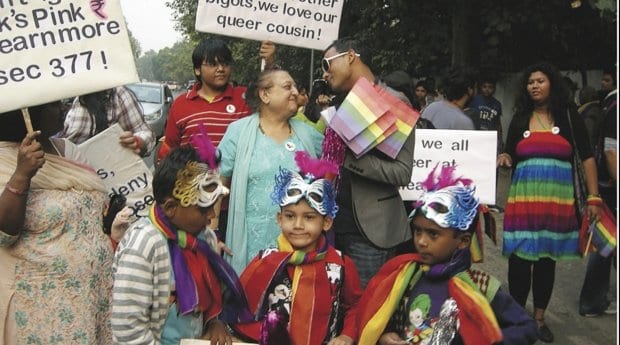
It all started in India. Under British rule in the former colony, it became the first country to write laws criminalizing homosexuality. Enacted in 1861, Section 377 punished “carnal knowledge against the order of nature,” catalyzing the movement that would see generations of gay people across the globe arrested, imprisoned and executed. It was then used as a template for similar laws in Canada, Australia, the Caribbean, East Africa and even Britain itself, which had no similar laws at the time. Today, half the world’s existing anti-gay laws trace their origin to Section 377.
Given her focus on international LGBT rights, it seemed only logical for filmmaker Nancy Nicol to head to India in 2009 when the Delhi high court struck down the law.
“I thought it was a really interesting way to take on issues around oppression,” the York University professor says. “Looking at the treatment of sexual minorities through the lens and legacy of British imperialism and colonialism.”
Nicol’s film No Easy Walk to Freedom charts the journey of activists and their opposition. In keeping with past works, Nicol stays out of the way, letting those involved speak for themselves.
“A social-justice movement is itself a kind of discussion,” Nicol says. “I try to capture that dynamic through different contributors and their thinking on a particular issue. There’s always debate within social movements, and that’s a very positive thing because it’s the way we analyze and grow in relationship to social change. Documentary is a form that is completed not on the screen, but by its interaction with the audience. What makes good doc is something that generates discussion and debate.”
Nicol’s work is part of a larger project called Envisioning Global LGBT Human Rights. Composed of 31 partners in 12 countries, the interdisciplinary research team looks at people fighting against anti-gay laws left over from British colonialism.
“People have heard about the situation in places like Uganda and they know it’s horrible,” Nicol says. “But sometimes they don’t know the extent of organizing and the brilliance and courage of people on the ground who are fighting to make change. What’s happening right now in India is powerful. It’s small in terms of the massive scale and diversity of the country, but it’s growing. India is the second most populous country on earth, so what happens there has huge implications for the rest of the world.”
No Easy Walk to Freedom
Sun, June 1, noon
TIFF Bell Lightbox, 350 King St W

 Why you can trust Xtra