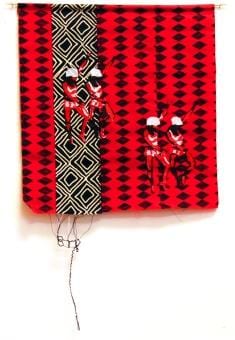
Nadijah Robinson stares at a blank white wall. The artist has arrived at Canteen to put up her art for an upcoming show. Where most artists arrive with cumbersome canvasses and a friend to assist, Robinson is carrying only a small bag. She pulls out an unassuming roll of fabric and begins to flatten six brightly coloured pieces.
They’re black and white and red, stereotypical African patterns hand-stitched together, three panels each. The pieces hang from small rods, each measuring about 12” by 12”. Stencilled on each are two hip-hop dancers. They’re ambiguous in gender and captured mid-move, just slightly out of step with each other. The six pieces form a mosaic of movement as she lines them up. Robinson begins to explain, gently untangling the raw threads that hang from each piece.
“There were these strips of African-themed fabric, ugly patterns. They just struck me as cheap, faux-African, an offensive imitation in the most simplistic way. I was just so attracted to it.”
Robinson, who is originally from Toronto, is a new graduate from Ottawa University’s fine arts program. With multidisciplinary tendencies, the project was her backlash against the tightly wound limitations of her third-year painting class.
“Painting is so wound up in European history,” she says wearily. “By the time I was doing this project, I was so burned out. I couldn’t paint another thing, so I chose to do this.”
“I’d been reading about the history of hip hop, just fleeting things about hip hop’s African roots. The state of mainstream hip hop has become so far removed from any meaningful cultural practice. So when I saw this fabric, so faux-African, it just screamed hip hop, so busy and bright with this near-audible energy. It embodied what had been on my mind, what it means to be African.”
Robinson identifies as a mixed-race queer woman of colour. With a father from Barbados and a Goan mother who grew up in Uganda, Robinson explains that her art both expresses and explores her roots.
“The continent of Africa is my ancestral home, and it’s the place that my mother considers home. So it’s a complicated: it’s home but it’s not home.”
Robinson has been an active member of Agitate during her five years in Ottawa. The collective of queer people of colour explores themes of race, gender, class and sexuality through activism and events, book clubs and discussions. She acknowledges Agitate’s presence in her musing on identity.
“Agitate is one of the things I’ve loved the most about Ottawa. Because it’s interesting negotiating the validity of this experience. I try to claim this place, Africa, as my home, but it’s not claiming me. It’s a weird feeling of belonging and rejection.”
Having finished her degree at Ottawa University, Robinson is returning to her family in Toronto. She’s considering teachers college, intrigued by the idea of teaching art and politics to high school students. So this statement on the African Diaspora identity might be her last art show in Ottawa for a while.
“Generally, because I feel like an outsider most of the time, in terms of my position in society on the margins, I look at things like I can critique because I’m not part of it. But while this art reflects my place in society, it also has a wider appeal. What I see is not necessarily what others see. It’s not art of the margins, for the margins. It could be about hip hop, it could be about African dance, it could be about romanticism. I’d like people to enjoy it for many reasons.”
Catch Nadijah Robinson at Canteen Art Shop and Gallery, 238 Dalhousie St, until May 30.
 Why you can trust Xtra