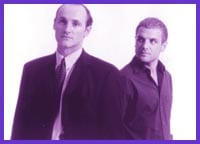
Colm Feore is on a roll. He’ll be all over multiplexes this year with parts in the World War II epic Pearl Harbor and Steven Spielberg’s A1 (starring Jude Law), and he’s appeared in such Hollywood films as Titus, City Of Angels and The Insider.
So what’s he doing in a low-budget Canadian film that will do little to raise his profile or enhance his career south of the border?
“It was a good part and it was well written,” he says, referring to the character of Ryan in The Perfect Son. And after receiving a Genie nomination, it appears his instincts have served him well. (The Genies are announced Mon, Jan 29.)
A successful lawyer who has cut himself off from his family, Ryan is reunited with his fresh-from-rehab younger brother Theo (played by Traders star David Cubitt, also nominated for a Genie) at the funeral of their father.
As the brothers tentatively begin to rebuild their relationship, black-sheep Theo discovers that Ryan is not the “perfect son” his family always believed him to be. In fact, Ryan has kept his homosexuality a secret and is now dying of AIDS.
It was the dichotomy between public face and private man that drew Feore to the role. “Here’s the genius of the Ryans of this world,” Feore says. “Their contention is, ‘It’s none of your fucking business. I’ve made my peace with it, organized it, compartmentalized it. Anyone who needs to know, knows.'”
And yet, as Ryan’s illness takes its toll, Feore says, “he’s more open and vulnerable to all kinds of different things that you wouldn’t expect someone like that to be.”
Rather than an AIDS film, Feore sees The Perfect Son as a story about family, particularly the link between brothers who, on the surface, have absolutely nothing in common.
Ryan and Theo, says Feore, “work out their lives in a different way; they repel each other until they can find the places where they connect.” Indeed, the prickly chemistry between the classically-trained Feore and method actor Cubitt is one of the great strengths of the film.
The Perfect Son is based on writer and director Leonard Farlinger’s own life. “Some of it came from my personal life and some of it came from the lives of other people,” says Farlinger. “I have a brother who died of AIDS. I have three or four friends who died of AIDS. But the film isn’t about death; it’s really about life and birth and rebirth. And it shows how an older brother inspires his younger brother to believe that life is worth living.”
Farlinger has worked as a producer, assistant director and actor; The Perfect Son is his feature debut as a director.
Besides seeing what he calls “two strong, powerful performances by great Canadian actors,” Farlinger hopes that audiences viewing The Perfect Son will be moved enough to try to resolve problematic relationships in their own lives. “Why does it take a horrible tragedy or crisis in our lives to get us to give a shit about one another?” he asks.
“If I could make movies for the rest of my life that encouraged people to just tolerate people for who they are and what they want to be, I’d be such a happy guy.”
 Why you can trust Xtra