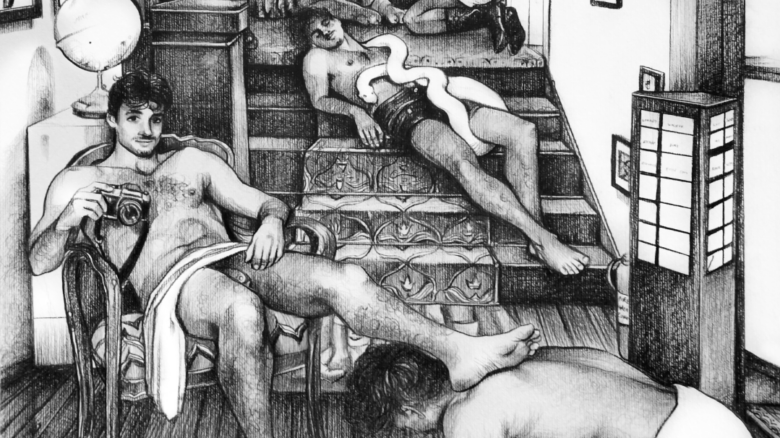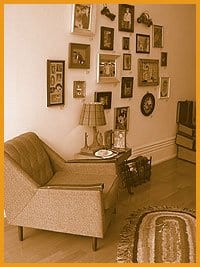
If you do not have a nice old man in your life, Lex Vaughn will gladly introduce you to her friend Peanut Brittle (alternately, she will introduce him as PB). Peanut Brittle is both the name of a character and of Vaughn’s new solo exhibition at Katharine Mulherin Gallery. Vaughn has disguised the gallery as PB’s dwelling. The space looks like something between a yard sale and an art show. Mr Brittle has most of what he needs to get by: a bed, a bathroom, a work area and a comfortable chair to lounge in. His walls are filled with portraits of his friends, a stack of mail and a few bedside girlie pictures.
Although the gallery is filled with personal bric-a-brac, there is a strong sense of emptiness in Peanut Brittle. The gouache and pencil crayon portraits of PB’s friends emphasize his disconnection with modern life. They suggest he lives in a world that is at least part cartoon. This man’s heyday is clearly over. He is not retro chic, but is plainly stuck in the past. Even his razor and “Gastro-majic” antacid pills are woefully outdated. One gets the impression that PB is a friendly, but friendless man left untouched by social progress.
After getting over the incidental irony of Deliverance From Disaster (Vaughn’s final exhibit with Allyson Mitchell as half of the duo Bucky And Fluff) it is nice to settle into PB’s apartment and see what Vaughn produces on her own. In agreement with her previous work, Vaughn mizzles the lines not only between art and craft, but also between collection and presentation. This is not simply a grouping of Vaughn’s drawings and scavenged trinkets but, rather, a specific character’s collected memories. Visitors are invited to root through PB’s possessions, becoming participants in Vaughn’s game. Upon entering the gallery, Vaughn herself, in Peanut Brittle character, greets each person as though he or she were an old friend, sharing stories, showing off treasures.
Although the work in Peanut Brittle relates a specific set of experiences, there is a sense that this man’s life is interchangeable with any of the other men in Vaughn’s portraits. They all seem to share a close relationship to a fashion of sorts. PB’s acquaintance with men of similar age and style is involuntary. He shares knowing nods and camaraderie with every other man stuck in the same past that he is.
By alluding to one man’s history, Vaughn has snuck her way into a lonely subculture, or something very much like it. Vaughn plays with the archetype of a slightly disquieting older man, and is able to induce empathy toward him. It does not feel as though she is mocking anyone with her exploration of male culture. Instead, the work is an inviting and sincere attempt at understanding a fading version of masculinity and style. Most everyone will have an idea of the type of person Vaughn is referring to. It is through her fiction that we get a better glimpse of a life filled with pride and longing.
* Peanut Brittle closed Aug 15 at Katharine Mulherin Contemporary Art Projects; go to Kmart- projects.com. Lex Vaughn is part of Evalyn Parry’s Cheeky Cabaret at Harbourfront on Sat, Aug 28.
 Why you can trust Xtra