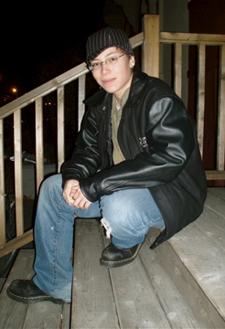
When Kris Figueroa figured out he was transsexual, he felt a mix of things. Anxiety over the complications — like which washroom to use — and relief, in finding the gender he could identify with.
Both were quickly replaced by loneliness. The 17-year-old moved from New York City to Halifax to be with his girlfriend who was only attracted to women. They stayed together as a lesbian couple and Figueroa suppressed his identity.
That same year he met another trans person — Julien Davis. Davis is the support services coordinator at the Youth Project — the only organization in Atlantic Canada that supports people 25 and under struggling with their sexual orientation or gender identity. Figueroa started hanging out at the Youth Project house, and within a year, he was sitting on the board.
Tonight, the 22-year old sits cross-legged on a couch in the Youth Project house — planning the organization’s 15th anniversary this Saturday night. As chair of the board, he’s in charge of leading the meeting.
The Youth Project started as a field placement for Maura Donovan in 1993, as part of her social work degree at Dalhousie University. Though most people went to existing agencies — Donovan wanted to start her own. She’d been involved in a gay youth support group years earlier that shut down and knew there was a huge demand for it.
Donovan put up posters and handed out flyers for the first meeting during Pride week. Leighann Wichman, a 21-year-old studying sociology at Dalhousie picked one up and went. It was her first time talking about being gay. She went through all of junior high with no support or information and was afraid of coming out.
After that meeting Wichman kept volunteering and later that year — came out to her parents. In 1998, when the Youth Project got funding from the federal government, she applied to be a full-time executive director and still is.
The Youth Project house, nestled in the north end of Halifax, is run by three full-time and two part-time staff. In the window hang strings of rainbow-coloured paper lanterns and a flag that says LGBYP. On the bright yellow and blue walls hangs a poster with queer politicians and a collection of mug shots with youth holding signs that say “out since…” followed by dates.
Throughout the week are movie nights, a drop-in centre and support groups. The house has a library, video games, movies, foosball tables and a TV. “The most important thing is the social aspect,” says Lindsay Dauphinee, the 19-year old secretary for the board. “Just hanging out with someone who goes through the same stuff as you when you feel alone.”
As well as the support they provide in the house, the Youth Project holds workshops on homophobia at schools around Nova Scotia. The demand for their one-hour sessions has been so high — about five a week — they’ve hired a part-time staff member just to give the presentations.
Wichman says they focus on doing workshops in junior highs, because most youth are now coming out between 11 and 14 years old. The Youth Project has adapted by changing their support group from nighttime to afternoon and setting up a parent’s lounge — where parents can talk about their child’s coming out.
“There were I lot of things I didn’t worry about,” says Wichman, of coming out at 21. “I wasn’t living with my parents and the high school part was over.”
Another change is the focus on trans issues. The organization now holds presentations every two weeks for doctors and teachers that cost $70 a person — they’re continually sold out.
Every year, the department of health gives a book on sex education to grade sevens. Wichman sits on their committee, and this year for the first time she convinced them to use the word transgendered in addition to male and female. “Every transgendered youth now knows they count just because of that word,” she says. “Without the Youth Project, it wouldn’t be there.”
Figueroa has come a long way in accepting himself as transgendered. He’s starting testosterone injections in January and having top surgery in February.
“I don’t know where I’d be without the Youth Project or how I’d meet friends,” he says, wearing a black T-shirt and pin-striped hat. “I’d still be trans, I just wouldn’t have told anyone about it. I’d just stay in my apartment.”
Instead, he’s on the wall, proudly smiling along with hundreds of others. Kris F: Out since Jun 28, 2004.
 Why you can trust Xtra