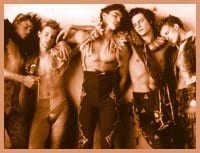
“In my fantasy,” confesses world famous fashion photographer Bruce Weber, in his latest film, Chop Suey, “I would be one of these kids – clowning around without a care in the world.”
Over a background of playful, nearly naked male models, Weber talks about how, as a kid, he would adore from afar the athletic boys at his family’s country club – but when his mother would tell him to go shower for dinner, he couldn’t. There would be too many boys and men in the shower room. Instead he would wash up alone at the sink still wearing his underwear.
“We sometimes photograph things we can never be,” he concludes.
Masquerading as a feature, Chop Suey is essentially a short film about Peter Johnson, high school wrestling Adonis turned fashion model. This one-note obsession is padded with sections dedicated to Weber’s other interests: fashion mogul Diana Vreeland, jiu jitsu fighter Rod Gracie, surfer Christian Fletcher and out lesbian nightclub performer Frances Faye. Their connection to the main subject is non-existent and when Weber makes the stretch to have pretty boy Johnson sit and reminisce with Faye’s surviving lover, it borders on ludicrous.
If you view Chop Suey, Weber’s fifth feature film, as a criticism of Weber’s (and the gay community’s) obsession with male beauty, it is at times very insightful. But for Weber, as the filmmaker, these moments of self-exposure are few and far between.
The photographer is invisible in a film about his own photography. He appears only fleetingly at the edge of his frame – which is still dominated by young, hot fashion model demi-gods. You can see in the film’s subtext that Weber still thinks he’s ugly and longs to be someone else.
This undercurrent is interesting because of Weber’s control over male fashion and gay erotic images for the past two decades. Barely a gay man exists who hasn’t wiled away time leafing through coffee table books, celebrity magazines or fashion spreads full of his legions of handsome men in idyllic settings. Having worked in the ’60s and ’70s to push the male model into the spotlight with such magazines as GQ, Weber has created such dominant gay icons as the Calvin Klein underwear models and the Abercrombie And Fitch boys.
Contrary to what you might think, Weber has never been explicit about his own sexuality. If his obsession with male beauty is fueled by a desire to be someone he is not – what does it mean when the gay community adopts his hyper-masculine visions of wrestlers, Marines, prisoners, boxers, surfers and skateboarders?
* Chop Suey screens at 8pm on Sun, May 26 at the Paramount; it’s the festival’s closing gala and costs $25.
 Why you can trust Xtra