
Credit: Constance Hoffman
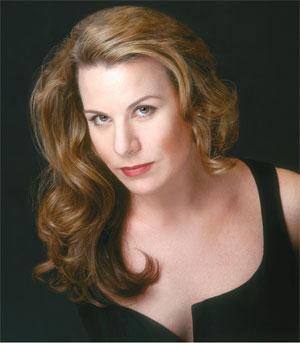
Laura Tucker describes her latest character as “dark and disturbed, struggling with a lot of anguish.”
Mezzo-soprano Tucker plays Prince Orlofsky in the Christopher Alden production of the Canadian Opera Company’s new Die Fledermaus.
“I get to show my own dark side and don’t have to worry about being likeable. It’s something many female singers have to learn to do. As a Russian émigré in Vienna, Orlofsky is isolated and in search of a place, and this whole production is, in a way, about isolation and the relationships that are difficult and torn apart.”
Not a frothy, pastel-coloured Die Fledermaus, this one. Orlofsky, the host of the ball that is the central event of the operetta, often gets played as a camp or straightforwardly comic character. Not so much here. “There is some laughter. I mean, I am a woman playing a man speaking German with a Russian accent, so there’s that. He is also volatile, and his highs and lows can be really funny. But at his core, this Orlofsky is twisted, angry and extremely vulnerable.”
A good Orlofsky is not a small feat. The role is among the pantheon of crossdressing roles for mezzos, with a long history of glorious performances, clips of which are always just a short YouTube search away. “It is intimidating but also hugely inspiring. Orlofsky doesn’t get to sing a lot, but his main aria is tricky business, and he’s always onstage, always acting or making the action of others possible.” The Viennese ball here is a sort of a sexy pyjama party for the wealthy. “I’m wearing a short wig and a silk, slouchy pyjama suit.” No monocle, but a cigarette holder is very likely.
And how does she create the physicality of a pants role? “It’s to do with the centre of gravity . . . adjusting where you feel the centre of you and having your body follow. With male characters, the centre is lower and you feel it. It’s liberating, vocally to do that; everything somehow gets deeper and more square as a consequence.” Recently, Swedish mezzo-soprano Malena Ernman published an article on kinging up for the role and the difference that a strategically placed sock padding makes for creating a character. Many mezzos swear that when costumed as men, they do feel more entitled and more aggressive about pursuing their wants. Tucker agrees wholeheartedly. “Why is it given to the male species to feel that way? Why is it that we learn it all so well through culture? Why are we so easily trained to be nice? . . . That is the question.”
Tucker’s connection with the COC is marked by milestones. She made her professional debut here in 1994 in Mozart’s Il Re Pastore: Richard Bradshaw had heard her sing Ottavia in a Juilliard production and invited her to Toronto. When she came again 10 years later, it was for Wagner’s Ring, during which she met her spouse, soprano Adrianne Pieczonka. (In the intervening years she sang in Portland, Seattle, Washington, NYC, Boston and London.) Orlofsky is her return to singing after a few years dedicated to parenthood.
When asked what roles she most covets, Tucker lists Eboli, Adalgisa, Carmen, Octavian, Sesto, Brangäne and Ottavia. “I am a lyric mezzo but with heavier potential . . . There are mezzos that are singing all these roles in a healthy way, somebody like Michelle Breedt or Sonia Ganassi.”
Ontarians will be able to see Tucker next in a recital with her spouse at a benefit concert for the Hamilton Philharmonic Orchestra in mid-December. But first, Orlofsky. “I am really enjoying this production, and singing again. I feel ecstatic going to work every day. I find myself thinking, How could I have been without my voice for so long!” How indeed. Bring out those monocles, casting directors. This mezzo is back.
 Why you can trust Xtra