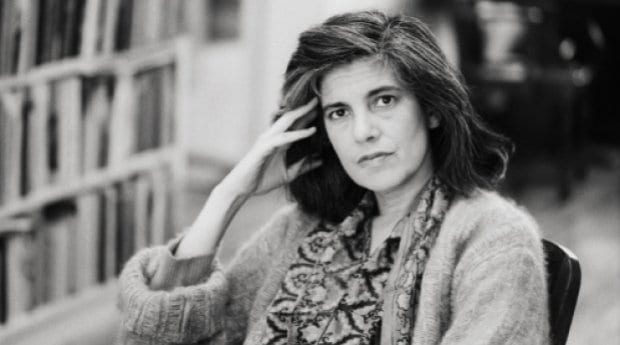
She was one of the most influential thinkers of the 20th century and also one of the most controversial. Her contributions to everything from fiction to film to philosophy shaped the consciousness of a generation and continue to influence today’s artists and thinkers. With her intense, piercing gaze and shock of unruly dark hair, crowned with a famous white streak later in life, Susan Sontag is a figure of endless fascination, at once outspoken and mysterious.
With Regarding Susan Sontag, filmmaker Nancy Kates presents an intimate and nuanced portrait of the writer, as told by those who knew and loved her best. The film reads as a sort of collage; interviews with Sontag’s friends, family, colleagues and lovers are interspersed with passages of her own writing, read by actress Patricia Clarkson and often presented in Sontag’s spidery yet elegant handwriting. Handmade filmstrip sequences heighten the pieced-together motif, as the non-linear storytelling weaves a methodical and intimate portrait of a woman who was fiercely intelligent but also undeniably human.
The documentary follows Sontag’s childhood in New York, Arizona and California. Born to mostly absent Jewish parents, she was a precocious child who read voraciously. A wife at 17 and a mother by 19, Sontag soon left her domestic life to travel and study abroad, experiencing a sexual awakening while studying at the Sorbonne in Paris, where she experienced her first serious lesbian relationships.
Known for her hatred of labels, Sontag refused to come out publicly for much of her life. She finally confirmed her bisexuality to her sister, Judith Sontag Cohen, at the end of her life. “[I told her that] I resented that she spent most of her life not being honest with me,” Sontag Cohen says. “She said that I was right and she was sorry about that.”
The film explores Sontag’s queerness, which had a tremendous influence on her life and work. Her 1964 essay “Notes on ‘Camp,’” her first major published work, defined the esthetic phenomenon that continues to be closely associated with the LGBT movement. Among her many lovers interviewed for the film are writer Harriet Sohmers Zwerling, playwright María Irene Fornés, choreographer Lucinda Childs and, perhaps most famously, photographer Annie Leibovitz, with whom she had a relationship that lasted through her final years.
The interviews with Sontag’s lovers are perhaps the most humanizing and poignant element of the film. Fiercely devoted to her work, Sontag could be selfish and arrogant, often treating her partners poorly. Yet from each of them a tremendous admiration is evident, as well as an awe for her lust for life. When Sontag died in 2004 at the age of 71, following her third and final bout with cancer, many described how she fought until the bitter end. “The way that she decided that she would face ‘it’ was to fight to the last breath,” says writer Steven Koch at the end of the film. “Fight, fight, every moment.”
Regarding Susan Sontag
Sat, Oct 25,12:15pm
ByTowne Cinema
325 Rideau St

 Why you can trust Xtra