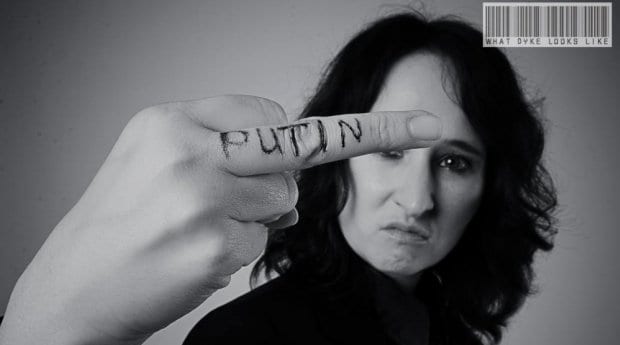
Some of the portraits of Russian LGBT people taken by photographer Kristy Boyce.
Kristy Boyce
When photojournalist Kristy Boyce travelled to Russia during the Sochi Olympics, she was less concerned for her own welfare than for that of the people she met. “I’ve felt in a lot more danger many other places I’ve travelled — I’ve literally been robbed by border bandits and surrounded by robbers in the middle of the daytime in South Africa — and Russia in February [is not like that],” she says. “In Russia, I spent a lot of time being paranoid, but I didn’t feel like I was in any danger. However, I did feel a responsibility to ensure I wasn’t creating a dangerous situation for people there.”
Boyce went to Russia to find out what life there is really like for queer people. She did on-camera interviews and photos with 35 people. “There’s a lot of fly-by-night journalism going on, where people swoop in from other countries, grab a quick quote and swoop out,” she says. “In my video stuff, you see people talking about what life is like in their communities and about any backlash they experienced since the anti-gay propaganda laws.”
It took some work to get her interviewees to open up. “When you interview these people, it’s hard to pin down what’s happened, because you can’t see it in front of you. They’re just sitting there drinking coffee,” she says. “A lot of the stuff is invisible, like a family that doesn’t accept their gay son or it happened months ago, when a gay bar was raided and a guy started shooting people.”
Boyce is well-travelled, having worked on projects across North America and in parts of Asia and Africa, but she is perhaps best-known for her project What Dyke Looks Like, a portrait anthology of queer women. In order to fight stereotypes — such as that all lesbians are burly, plaid-wearin’ gals — she designed each picture to capture something of the diverse identities of each subject.
While all of her Russian photos together will comprise a broader Russia-themed project, some of them will also be used as part of What Dyke Looks Like. “With a project called What Dyke Looks Like, it’s a bold statement — you can look like an asshole if it’s not fully inclusive, so I’m trying to make it more international,” she says.
Some photos will also be part of a whimsical sub-project called The Russian Bears. “I thought I was super-witty — what animal do you associate with Russia? The bear! — and then I found actual, burly Russian bears, so I’ve got a portrait series of them. I shot it a little differently; they’re often topless, and some of them are greased up. I’m not sure why; I just wanted them to be shiny,” she says.
Some material from the video interviews may end up viewable online for free, and she’s also considering cutting bits together to make longer videos. “One of the questions I asked is, ‘What would you say to Putin if you could safely say whatever you want?’ And so I’m kind of thinking of cutting all of those answers together,” she says.
As a thank-you to her supporters, Boyce invites people to come to The Flying Beaver to hear about her trip. The event will include photos, video clips, stories and a Q&A.
Russia and Back Again: Images from Russia’s LGBTQ Community is Fri, May 30, 7pm, at The Flying Beaver, 488 Parliament St. pubaret.com

 Why you can trust Xtra