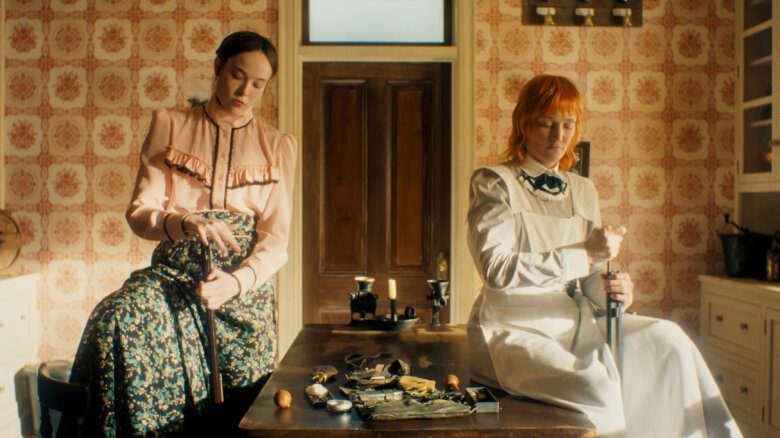

Director Alisa Palmer is married to writer Ann-Marie MacDonald. Credit: Promotional photo
In an early draft of a Declaration of Children’s Rights, Janusz Korczak writes, “Children are not people of tomorrow; they are people today.”
Korczak dedicated his entire life to creating a world in which children are respected and empowered.
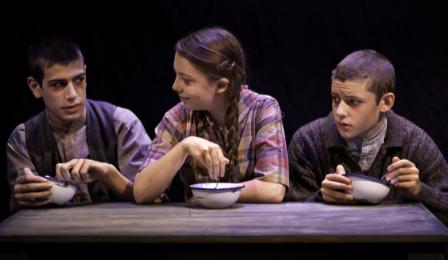
In Tarragon Theatre’s production of The Children’s Republic, a play written by Hannah Moscovitch and directed by Alisa Palmer, we encounter him running an orphanage in Warsaw during the Second World War, watching over abandoned youth in the ghetto while encouraging their talents and treating them as fully capable.
Moscovitch’s story begins with the arrival of an unruly new child named Israel, whose violent outbursts and thievery are a strain on the other children and Korczak’s partner, Stefa. As the conditions of the overcrowded ghetto deteriorate, the couple struggles to protect and feed the children with increasing despair.
In line with Korczak’s philosophies, the play’s argument unfolds primarily through the adolescent characters, whose rivalries and romances are dramatically underlined by traumas past and forthcoming. Tarragon’s young players perform admirably, inhabiting these dense roles with as much subtlety as wide-eyed enthusiasm.
“It was really quite a great challenge to work with kids. You get down to a lot of the basics, and there’s a risk involved in that,” says Palmer. “What was demanded of them was so complicated, but maybe they didn’t even know enough to worry about it. They just said, ‘Yeah, well this is possible, this is all possible,” and that attitude is incredible.”
Paired with the story of the childrens’ development is a careful portrait of two equally complex adult personalities. The muted maternal gravity of Stefa, played by the outstanding Kelli Fox, provides a dramatic balance to the frank and instinctive Korczak, brought to life by Peter Hutt.
“There’s a traditional gender flip that goes on with those two roles,” Palmer explains. “The male character has to put his heart on sleeve and reveal his vulnerability with a lot of warmth and emotional intuition, and the female character is the more authoritarian figure.”
The character of Korczak is indeed somewhat sensitive, more likely to engage in hilarious Jewish humour than the pressing issues that visibly occupy Stefa. The children, too, are prone to roughhousing and music in otherwise distressing situations. These moments of joy and comedy carefully lighten the mood of a depressing tale, allowing the audience to access the play’s upsetting subject matter through a more comfortable side-door.
“My experience is that survivors often use humour to get through things,” says Palmer, whose career as a director and playwright has consistently engaged with politics, history and trauma.
And although the play is not expressly queer, it resonates with Palmer’s experience not only as a lesbian – she is quick to remind that gays were in the ghetto, too – but also as a mother. As parents, she and her wife, accomplished Canadian writer Ann-Marie MacDonald, are engaging with many of the same issues around children that Korczak once did.
“We’ve become involved in a Montessori school, and Maria Montessori is a contemporary of Korczak. She started orphanages in Italy and created a system of pedagogy which is not dissimilar to Korczak’s,” Palmer reflects. “That was another reason I thought this play was so important, because in our lives we’ve had our eyes opened to ways of living with children that focuses on their empowerment.”
The Deets:
The Children’s Republic
Runs until Sun, Dec 18
Tarragon Theatre
30 Bridgman Ave
The production coincides with an exhibition on Janusz Korczak’s life and work
Runs until Fri, Dec 2
Miles Nadal Jewish Community Centre
750 Spadina Ave
 Why you can trust Xtra