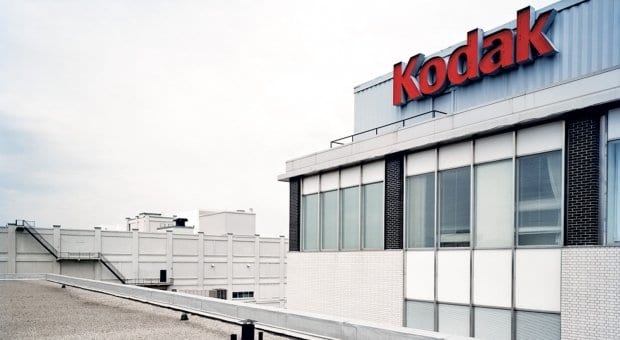
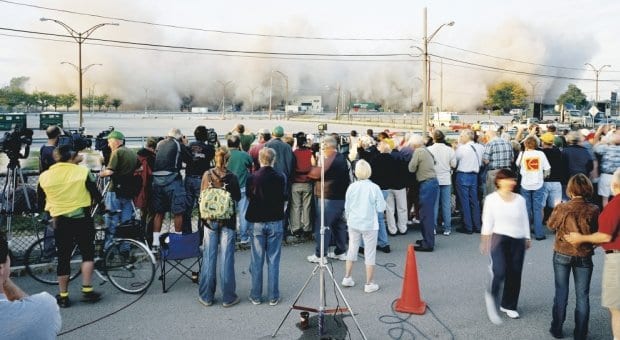
Robert Burley’s photographs capture the abandonment and demolition of Kodak Canada complexes. Credit: Robert Burley
Once upon a not-so-distant time, nearly every household in North America had a good old-fashioned film camera. But as cheaper, higher-quality digital models have flooded the market over the last decade, the medium has quietly fallen into near extinction. While many artists have lamented film’s demise, Robert Burley set out to document a specific aspect of it. His current exhibition captures the ruins of crumbling film production factories around the edges of North American cities.
“In 2005, I heard Kodak Canada was shutting down,” the Toronto photographer says. “At first I thought it was a downsizing exercise but soon realized it was just the tip of the iceberg. Over the next five years, all of the photographic companies found themselves in economic free fall.”
Like an archaeological survey of late-20th-century ruins, the exhibition captures these sprawling abandoned complexes in 30 large-scale prints and two grids of Polaroids. In a nod to the technology that wrought this empire’s downfall, there is also a video piece created from YouTube footage of several Kodak factory demolitions and a framed first-generation iPhone with a Facebook slideshow documenting an impromptu rave held in one location before its destruction.
“It’s ultimately a project about a time when photography changed forever,” Burley says. “It was an enterprise employing hundreds of thousands of people and an art form that shaped the world over the last century. I saw this shift as a significant moment in the medium’s history, which I wanted to record.”
A professional photographer for more than three decades, Burley is particularly sensitive to the transition, as it’s shown up relatively recently in his career. He confesses a certain fondness for the magic of the darkroom, watching images appear slowly in chemical baths instead of flashing instantly on glowing screens. But while he still uses both analogue and digital formats in his work, he doesn’t sound terribly optimistic about the old-school medium’s future.
“Sadly, this product was never manufactured as an artist’s material,” he says. “It was created for mass markets: consumers, Hollywood and other professional applications. All of these markets have switched or are in the process of switching to digital media. One of the facts that became clear over the course of this project is that film, unlike vinyl records, cannot be produced small-scale. At this point, its future is really unknown.”
Robert Burley: The Disappearance of Darkness
Fri, Oct 18–Sun, Jan 5
National Gallery of Canada
380 Sussex Dr
gallery.ca

 Why you can trust Xtra