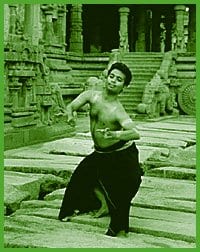
Bring on the courtesans! The imagination whirls with brightly hued, flowing silk, the clinking of bracelets and gorgeous painted faces. Is this just the stuff of film fantasy? No, it is actually a popular south Indian dance form called Bharatanatyam. And local choreographer Hari Krishnan and his inDance company is bringing Play, a suite of Bharatnatyam dances, to Toronto this month.
But Krishnan is offering up this classical art form with a twist as he himself will be one of the dancers – minus the bangles and flowing silk.
Born and raised in Singapore, Krishnan’s family emigrated from India in the early 1960s. Growing up in a family of dancers and musicians, Krishnan knew from an early age he wanted to be a dancer. His family sent him to study dance in the southern city of Tanjavur, which is the birthplace of Bharatanatyam.
Krishnan feels strongly that Bharatantyam is far too often confused as a 2,000-year-old temple dance when in actuality it originated 200 years ago in the palaces of Tanjavur. The original masters of the form were known collectively as “The Four Brothers” or the “Tanjore Quartet.”
Krishnan studied with a fourth generation descendant of the quartet in their ancestral home. From this source Krishnan learned the history of Bharatanatyam. The Quartet, fearing that this courtesans’ dance would not survive the moralizing of the British Empire, codified its steps and gestures. In doing so they saved Bharatan-atyam from certain extinction.
“It was during this period that the palace courtesans were reduced to the level of common street prostitutes,” explains Krishnan. Previously the courtesans were wealthy and independent members of Indian court society, wielding power and influence. Their dances reflected an independent spirit from a uniquely female perspective.
The choreography of Bharatan-atyam has passed from male masters to his female dancers, known as devadasis, for the last four generations. Traditionally Bharatanatyam is a text-based solo dance which portrays a woman’s emotional journey. Desire is the common theme.
Modern Bharatanatyam is now danced by both male and female dancers. Krishnan will be joined on stage by fellow dancers Sreyashi Chakraborthi and Rajkumari Chatterjee. Rex (who goes by one name), Krishnan’s partner of five years, is the costume designer. A five-piece ensemble provides the music at the core of this rhythmic dance piece. For those in the audience unfamiliar with the codified gestures, a narrator of sorts will subtlely interpret the narrative into English as it unfolds.
Krishnan, holding forth on a pet peeve, says that the myriad of regional cultures and art forms which make up India are often lumped into one homogeneous conglomeration and labelled exotic. Misconceptions about the origins of Bharatanatyam are an example. As Hollywood has done to ballet, so Bollywood does to Bharatanatyam.
“Don’t get me wrong, I think Bollywood is great, but it is not all of India’s culture.”
 Why you can trust Xtra