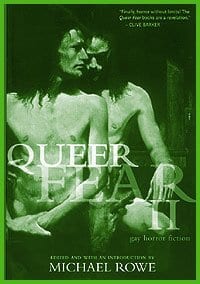
Calling this second anthology from Arsenal Pulp Press “gay horror fiction” may put readers off, but don’t be fooled. Instead, think of this Canadian collection as simply a horror anthology.
One gem in this mixed batch is entitled On Being a Fetish, by David Coffey. The protagonist describes the pitfalls of being a ghost, and gets his kicks from scared and horny teenagers who perform séances. His bittersweet and hilarious attempt at a long-distance relationship sets a standard for the rest of Queer Fear II. When stories fall short of this standard, you wonder how they got into the mix.
One such failure includes Night of the Werepuss, by Michael Thomas Ford. Sadly, this is exactly what it sounds like. A woman’s vagina decides to grow teeth, bay at the full moon and seek out prey. If the premise weren’t already laughable enough, the story suffers from being funny for all the wrong reasons as Ford describes the female protagonist’s attempts to apply a tampon while on the edge of her bathtub in order to deal with the “monthly departure of one of her unfertilized eggs.”
Of the 22 stories in Queer Fear II, 18 have gay male protagonists, two have lesbian protagonists and two are mixed. Of the male-oriented stories, some have references to high school closet cases with crushes on dusky or athletic fellow students.
Two delightfully creepy stories in this vein are Scott Treleaven’s Bugcrush and Ron Oliver’s Want. Bugcrush’s main character falls for a Henry Rollins lookalike who just transferred to his school, and the story has an uneasy, creepy, isolated high school tone. In Want, 17-year-old Dennis will do anything to have Cole Trotter, captain of the football team, look his way.
Gaytown, by Robert Boyczuk, also delivers unnerving, ambiguous imagery. Paul and Damien have dated for years, but Damien still refuses to come out of the closet or introduce Paul to his family. They roll into Gaytown, which consists of one gas pump, one bar, one Legion Hall and one hotel. Damien only sees what he wants to – straight couples. Paul sees everything as it is – something wrong in this strangely named hick town.
Several other gems make this collection worth reading. In David Nickle’s Polyhemeus’ Cave, the protagonist James returns to Chamblay for his father’s funeral. James has a boyfriend on the side back in Los Angeles and his return to Chamblay means James must confront the reason he left in the first place. This may sound tired, but Nickle’s treatment is original and startling – part campfire tale, part modern horror and part mythology.
Numbers, by Steve Duffy, is based on real-life horror, the advent of AIDS in the early 1980s. Told through monologues, dialogue and the journal entries of a kaleidoscope of different characters, it is richly chilling and impossible to put down.
Narrow World confirms Queer Fear II’s promise of loosening up storylines to progressive characters in both progressive tight spots and traditional horror situations. The bends in the stories are rewarding, despite weaklings that cause a few bumps along the way for things that go bump in the night.
QUEER FEAR II: GAY HORROR FICTION.
Edited and with an introduction by Michael Rowe.
Arsenal Pulp Press. 2002.
 Why you can trust Xtra