The city of Montreal has been the epicentre of chaos in recent months, and the student protests show no sign of slowing down after talks with the provincial Liberal government stalled.
Earlier this week, Martine Desjardins, president of Quebec’s university students’ association, FEUQ, promised that protesting students won’t disturb the city’s various summer festivals.
With the Montreal International Jazz Festival kicking off its 33rd year June 28, André Ménard, artistic director and co-founder of the festival, says that the focus of the event should remain on the music and that the protests have been overblown by the media. “The riots are localized. It’s always about 1,000 people walking the streets at night. Obviously, with the multiplication of information channels, [this] now gives a presence to that phenomenon that is way beyond its actual size.”
The size of the demonstrations was enough for organizers of another high-profile event, the Grand Prix, to cancel their free opening-day event.
Tourism Montreal released figures this week that show hotel bookings dropped by more than 10 percent in May, and another drop is expected for June.
Montreal resident Scott Thibault says although he hopes the festival will continue as planned, he’s worried the discourse will hamper the enjoyment of music lovers.
“It actually worries me, considering that there have been smoke bombs detonated in the Metro. It’s dangerous in the streets of Montreal at the moment because of other activists who are not involved with the students’ struggle that are causing problems.”
Thibault says the Jazz Fest would be a great psychological escape for those who have become tired of the ever-present demonstrations rocking the streets of Montreal.
The protests are just one of many challenges the event has grappled with in its history.
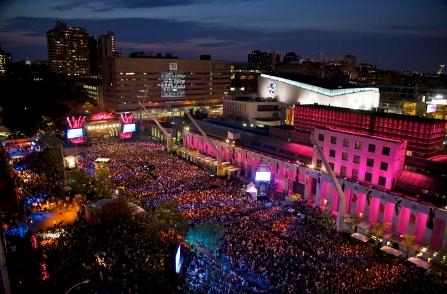
For many years the festival’s venue in the Quartier des Spectacles neighbourhood was marred by construction. This year the event will take place at a completed, construction-free site for the first time.
“Now there is this footprint of the Jazz Fest in downtown Montreal. That is very flattering for us, to see that we have changed the geography of the city,” Ménard says.
When the festival began in 1980, the province of Quebec was fraught with turmoil from the first provincial referendum. For its first two years the festival was held in the French district on St Denis, but in 1982 the venue was moved to its current staging grounds. Ménard says the move unified the citizens of Montreal, and concert-goers of all ethnicities and language backgrounds came out to enjoy music together.
The festival comprises more than 500 concerts and events spread over 10 days. Ménard describes it as two events in one: the large-scale, mostly free outdoor concerts, and the indoor niche concerts, which include big-ticket celebrities Liza Minnelli, Norah Jones, James Taylor and Seal.
Power-gay Rufus Wainwright, whose Mark Ronson-produced album Out of the Game was released earlier this year, will be the grand opening act at a free outdoor event.
Sure to draw interest from queer festival-goers is Flamenco Hoy, a dance performance by Spanish film director Carlos Saura. The piece features eight musicians and 12 dancers who will meld traditional flamenco moves with ballet, set against a mixture of pop and jazz music.
Other notable acts set to appear include indie darling Timber Timbre, electro-funk duo Chromeo, contemporary disco outfit Escort and living legend BB King.
There is truly something for everyone, Ménard says. While most of the daytime and evening concerts are family-friendly, many late-night events will take place in various clubs around the city.
Ménard says that although the ongoing protests are a challenge to the festival’s daily operations, its biggest obstacle is remaining relevant in terms of content.
“For many people, jazz peaked in 1959. From the moment they plugged in the first keyboard of the first electric guitar, that was not jazz anymore. We think that jazz is music that has influenced a lot of musical forms. So this is the main challenge: to remain available so that every generation finds something for them. We go from big techno music at night to big-band content in the afternoon. That is what is fun about the festival.”
The Montreal International Jazz Festival
Thurs, June 28-Sat, July 7
montrealjazzfest.com
Rufus Wainwright – Out of the Game

 Why you can trust Xtra