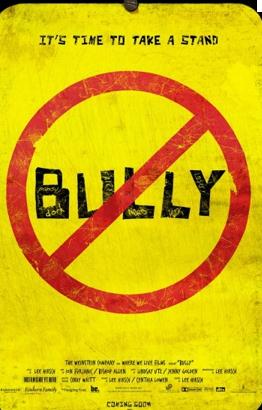
Weaving together stories that tackle what has deservedly and considerably become a hot-button issue, Bully, Lee Hirsch’s new documentary, should be a must-see for pretty much everyone.
After a year of playing the film festival circuit (it screened at Hot Docs last May), the film finally arrived in theatres this month.
The power of Bully lies in the manner in which it captures the intense isolation and loneliness of its bullied subjects (and, in some cases, their families). Take 12-year-old Alex, who serves as the film’s primary protagonist. Alex is beaten and stabbed aboard a school bus, and your heart will break for him.
Hirsch finds a substantial intimacy between Alex and the camera. He also brings out our rage as his camera captures the remarkably irresponsible behaviour of the school officials Alex goes to for help, namely an assistant principal who essentially ignores his issue altogether.
Sixteen-year-old Kelby is the sole representation of queer-specific bullying. She is an out lesbian living in an ultra-religious Oklahoma town, where she – along with her supportive family – is subjected to vicious attacks from the fundamentalist community the family was once a part of. Kelby, remarkably, survived three suicide attempts to find relative solace in a small group of like-minded friends. Her parents offer to move her to a different school, but Kelby refuses. She says it will simply encourage the bullies.
Understanding the perspective of Kelby, Alex and the other subjects in Bully (including 14-year-old Ja’Maya, who is in a detention centre because she waved a gun at her tormentors) is the key to knowing its potential. A potential aided by a significant profile thanks in part to the controversial decision south of the border that saw the Motion Picture Association of America hand the film an R rating, mostly because “fuck” is uttered several times. The rating, however, restricted the very people who could most benefit from seeing the film.
While the rating has since been reduced to a PG-13 (here in Canada it was PG from the get-go), the scores of free press the film received prior to this about-face should help give it the audience it needs to make a difference.
This is not to say Bully is the definitive documentary on the subject. Perhaps its biggest flaw lies in its failure to really offer any suggestions about how to stop what’s going on in the film. None of the stories end on hopeful notes – not wholly uplifting for those for whom the subject hits close to home. But what it does do is offer perspective and understanding, which is always a good place to start.
Below is an interview by Peter Knegt with Bully‘s director, Lee Hirsch, and its writer-producer, Cynthia Lowen.
 Why you can trust Xtra