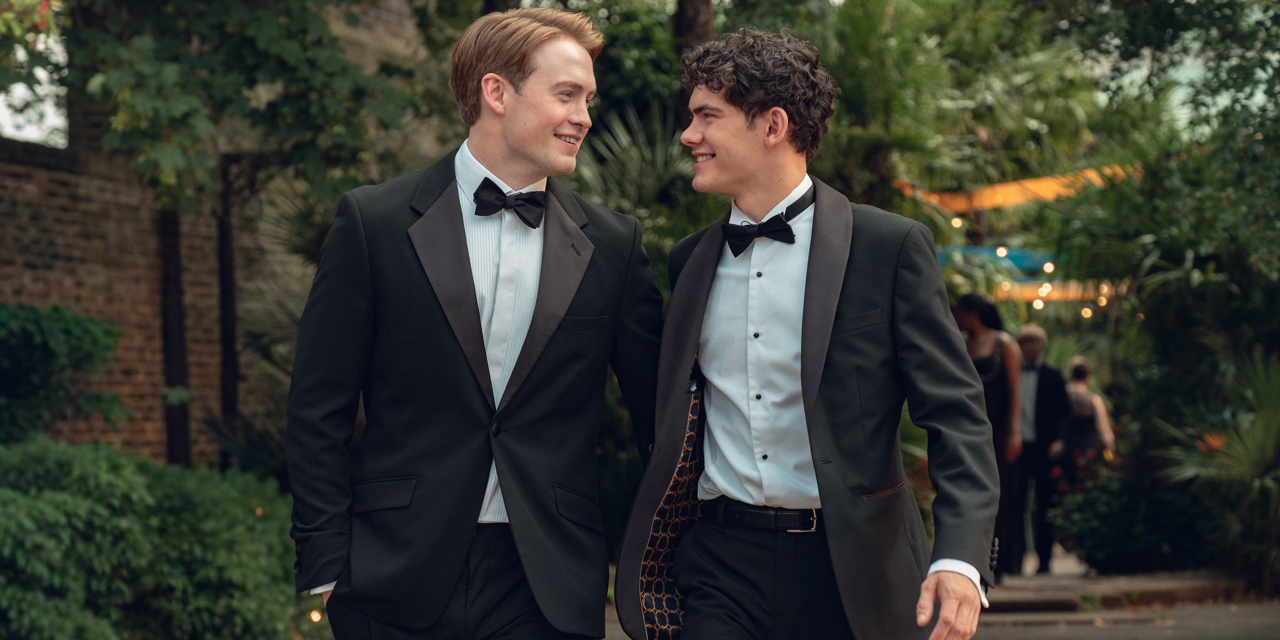
When Heartstopper premiered in 2022, it seemed to take over the world. Based on the Alice Oseman comics, the Netflix show features a gay teen romance between Nick (Kit Connor) and Charlie (Joe Locke). At the beginning of the series, Charlie was openly gay, and despite being bullied, continued to be fully himself every day, while Nick took longer to come out as bisexual. Through three seasons, Heartstopper followed their relationship through ups and downs, alongside the journey of their queer friend group. The show was a hit, and all anyone online could talk about was this sugary-sweet, lovey-dovey coming-of-age romance between two boys. Everyone seemed to love it. It felt revolutionary.
We’ve had tons of shows with queer teen romance before. When I was growing up in the early 2000s, Degrassi: The Next Generation (particularly the character of Marco Del Rossi) and The United States of Tara were most influential. But in those shows, and others like them, the gay characters weren’t usually the main characters, and they only had minor storylines. Heartstopper put gay romance front and centre. Importantly, trauma was nowhere to be found, and the show put queer joy above everything else. It gave us this sweet, ultra-adorable relationship that so many of us would have clung to in our youth, and now for those who did grow up watching it, an incredible sense of confidence.
Four years later, the series comes to an end with Heartstopper Forever, a streaming film that functions as the series finale. The boyfriends face their biggest challenge yet: Nick is set to head off to university on the other side of the country, and his relationship with Charlie is in turmoil. It’s a brave evolution, daring to be sexier and more adult, while maintaining the charm and kindness that infused the series. Directed by Wash Westmoreland and written by Oseman, it’s even better than the series that precedes it.
Yet seeing the movie was difficult. That’s because watching Heartstopper Forever made me wistful for what I felt I’d lost—how remarkable could my own high school experience have been if I’d had the courage to be like Charlie? But it also made me happy for what I did (and do) have.
I attended high school in Ancaster, Ontario, from 2006 to 2010. I had a great group of friends, some of whom I still consider my favourite people. By the time I graduated, people outside of my friend group seemed to generally enjoy my presence, or at least that’s what I understood by winning the yearbook superlative of “Wonderfully Witty.” Humour, for me, came easily. I could think quickly. Yet throughout high school I felt like a ghost, floating above myself, seeing someone I understood, but didn’t really know. Telling jokes meant I could deflect away from my actual self, silly asides functioning as a shield, quick barbs my sword.
I knew I wanted to write about movies, and got published a couple times in my local paper, The Hamilton Spectator, but beyond that, I didn’t consider my career prospects much. One exchange in Heartstopper Forever pummelled me with its perceptiveness:
“I hardly think about the future at all,” Charlie says.
“It’s because you were busy surviving,” his friend Isaac responds.
I started getting bullied about being gay in Grade 6, long before I figured it out for myself. A friend started a rumour that I wore makeup. That wasn’t technically a lie, because I was in a production of Joseph and the Technicolor Dreamcoat, where everyone in the show wore makeup. My “friend” was also in the play, and also wore makeup, but that nuance was lost on everyone, and I wasn’t interested in humiliating him like he’d done to me. Kids called me every name in the book. I still have a vivid memory of eating my lunch when a boy came up to me and called me a “transvestite,” a word I had never heard. I doubt he knew what it meant either, but it stung.
Fast forward to high school: I still hadn’t realized I was gay, though everyone else seemed to. People I’d never met before would come right up to me, say “faggot,” and walk away. I’d be elbowed in the hallways. Perhaps the strangest thing was that by high school, I spent most of my time as a walking advertisement for the Minnesota Vikings, an NFL team. They’re still one of my greatest passions in life, and I’ll miss just about anything to watch their games. I wore a Vikings jersey in every yearbook photo. It was partly a way to amp up a perceived masculinity, but I really did love the sport, and knew more about it than just about anyone. I also told people how in love I was with Beyoncé and Eva Longoria, but looking back, telling people I was into a pop diva and the star of Desperate Housewives was an enormous tell, even if I didn’t know that then!
In Heartstopper Forever, Charlie is steadfast about changing the culture at his school: “I want to destroy the homophobia that made my life hell,” he says in his speech for the role of Head Boy (the U.K. equivalent to class president). One of the ways he wants to do this is by creating Pride Club, a group that fosters inclusion in the queer community. It’s a message the student body is impressively receptive to: Charlie wins the election with 61 percent of the vote.
Toward the end of my time in high school, Positive Space, a club designed to be a safe haven for queer students, was created. I found the name hilarious, if deeply ironic, because a) nothing I was feeling about my identity felt particularly positive and b) being part of Positive Space felt like announcing myself as a target, when I’d already been pushed around enough. “Positive Space,” in my mind, was a place not unlike the one depicted a few years later in the pitch-perfect 2013 satire G.B.F., in which a bunch of straight people sat around a table hungrily anticipating an actual queer person to finally join the group.
Despite my hangups, I was still interested in seeing what Positive Space actually was, if only to see who was in it, partly out of genuine curiosity, but mostly so I could see other people who were experiencing what I was going through. I remember asking close friends of mine at the time, two brothers who were the sons of one of my teachers, what they’d think of people in Positive Space. They said they’d pray for them, which to me felt even crueller than the idea of outright bullying. I internalized it, taking it to mean that they thought there was something so fundamentally wrong with being gay that the only solution would be to pray to a higher power to fix them. I never went to Positive Space. I wish I did.
The most touching subplot in Heartstopper Forever follows a new young boy, Alfie, who gets bullied for being gay, and how Charlie, who used to experience that same torment, becomes his safe space through Pride Club. In the first few years of high school, I hadn’t seen a single openly gay person, and felt terribly alone in harbouring the knowledge that I was different, even if I hadn’t quite figured out I was gay yet. By then I’d hooked up with a male friend semi-regularly and in secret, though neither of us considered it gay.
For Alfie, Charlie is his hero, a beacon of light that shows him no matter how cruel people can be, there’s a gorgeous rainbow light at the end of the tunnel. For me, that was David. David transferred to our school when I was in Grade 12. I was quietly thrilled to hear that there was a gay guy at school, partly because it took the heat off me. David seemed so confident in himself. I was mesmerized. Seeing him with his star tattoos (Tattoos! How rebellious) and his Wall-E backpack (one of my favourite films), I was smitten.
David and I started talking. Hardly in person—I was too much of a coward for that. Like Nick and Charlie did on Instagram in Season 1, we’d chat on MSN Messenger about our mutual love of films, posting various soundtrack clips on YouTube on each other’s Facebook walls.
Heartstopper uses lovely hand-drawn animated flourishes of butterflies and hearts fluttering when characters are overcome by new feelings. The more I spoke to David, the more I saw my own burgeoning emotions bursting through in vivid colour. But with those came memories of being bullied, and swirling around me were off-the-cuff comments people made (a good friend of mine was happy to share that being gay was “disgusting” and a “disgrace”).
Eventually, David asked me out on a date via MSN. We planned to see a movie at the Movie Palace, a cinema in Hamilton that has since tragically ceased operations. I was euphoric, until the fear immediately kicked in. He then sent me a friend request on Facebook, declaring we were in an open relationship. I don’t think either of us had any idea what that meant. I never accepted, leaving it lingering in my notifications, knowing that it served as a coming out I wasn’t ready for. Instantly, I called my best friend Beth and told her everything. She was predictably amazing about it. And honestly, so has everyone I’ve ever come out to, including my parents.
One reason why so many complain that Heartstopper is mere wish fulfillment is because it’s hard to watch someone living out a life that you covet when achieving it feels impossible. Things have changed so much since I graduated high school 16 years ago. Today, most young people seem to know someone who’s queer, non-binary or trans. Practically everyone in the Heartstopper friend group is in the queer umbrella. The fact that that isn’t unrealistic anymore is extraordinary to me.
In 2010, I was preparing to go to university, just like Nick in Heartstopper Forever. David would remain in high school as he was a grade below me. The distance between us wouldn’t be a four-hour drive like Leeds is to Charlie’s hometown, but a seven-hour flight, because I was going to do my undergraduate degree in the U.K. Maintaining any sort of romance would have been fruitless, and David and I both knew that.
The ending to this story isn’t a tragic one. We remain friends, and getting to hang out with him when I come home to visit is always a highlight. After moving overseas for university, I found peace with myself. Outside of my high school’s walls, I found my confidence, and at university I didn’t hesitate to come out to anyone. Several years after graduating university, I found my person. We got married in 2018 and have built a brilliant, beautiful life together. He’s my rock. Nobody has ever made me feel better or more confident in myself. Watching Heartstopper Forever made me so overjoyed to know what an impact this show will have on young people, and how it’ll help them realize their existence as queer people isn’t strange or wrong. It’s beautiful and worthy of celebration.
I’m grateful for what I did have back then. My friends, David, my parents, who were always supportive of who I love and what I do. Still, I’m sad I didn’t feel like I could be honest and out like Charlie or his friends, even though I’ve ended up in a love that feels so good sometimes I fear I might wake up from a dream and it’ll all be over. I can’t help but feel like if I had seen Heartstopper as a child, I’d have proudly walked my school halls, still decked in Vikings apparel, but with a boy’s hand in mine. Maybe I could have felt like a superhero.
It’s gutting to think Heartstopper Forever is the end of such a powerful, valuable experience for queer youth. It feels like the end of an era for LGBTQ2S+ television; GLAAD reported that 41 percent of LGBTQ2S+ characters on television won’t be returning as their shows have ended or been cancelled. Heartstopper felt like a watershed moment. Now, it feels like it’ll once again be a rarity for queer youth to discover they’re not alone through the TV screen.
Through Heartstopper Forever, Westmoreland and Oseman have created something profoundly honest without sacrificing the sincerity and sweetness that made Heartstopper special. And though it brought back difficult memories for me, it brought back exquisite ones too. I’ll be grateful for that—forever.

 Why you can trust Xtra